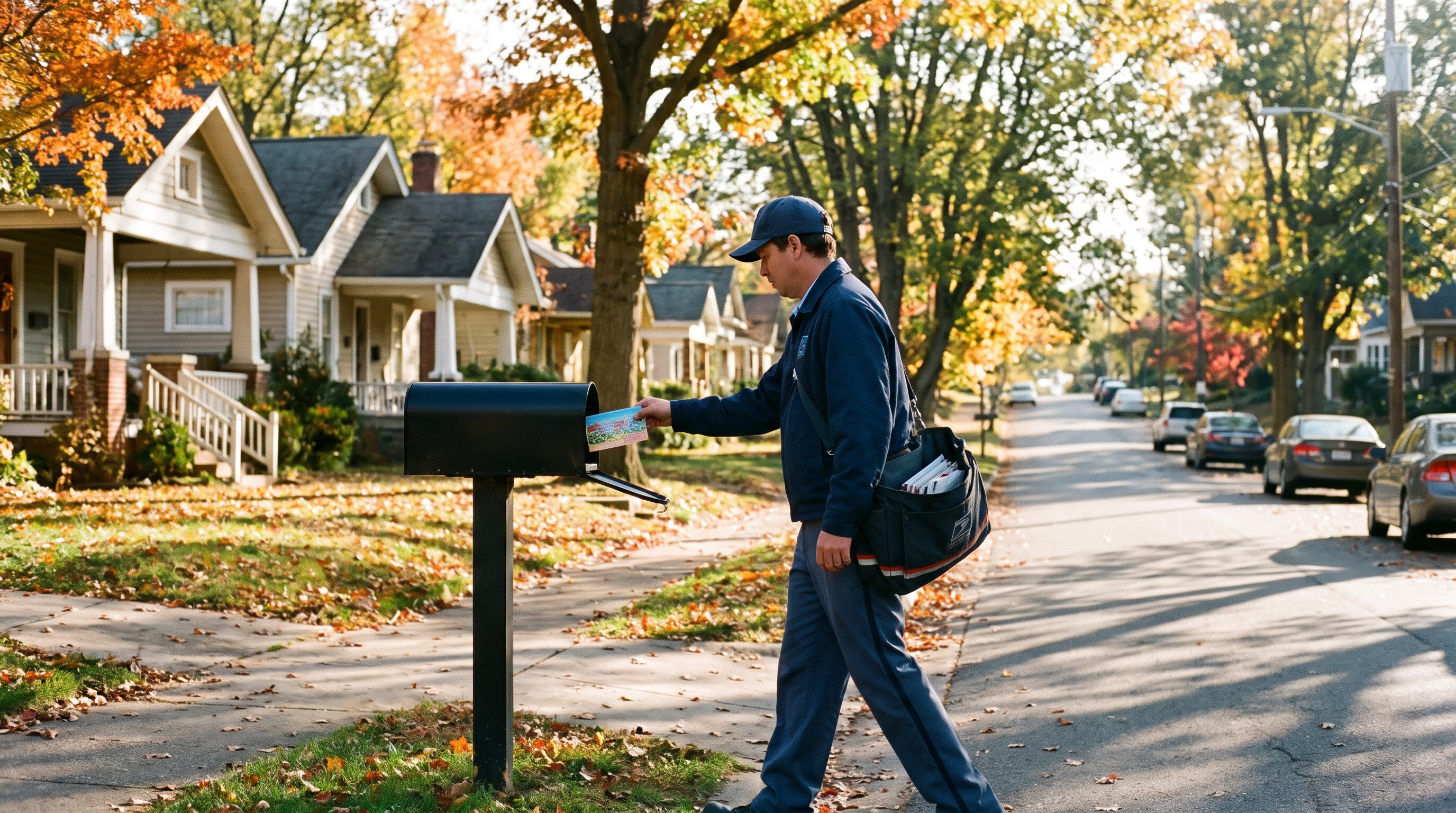
You can mail a printed offer to every home on the streets you choose without buying a list, without knowing anyone's name, and without a mailing permit of your own. The USPS calls it saturation mail — the self-serve version is branded Every Door Direct Mail, or EDDM. Instead of addressing each piece to a person, you pick the letter carrier's route on a map and the carrier delivers one to every door on it. You choose the streets; the post office handles the addresses, because the carrier already knows them.
At BrandBoostPrints we print in Spokane and mail under our own permit, so the part that trips people up — bundling, facing slips, hauling boxes to the right postal unit — isn't yours to do.
What saturation mail (EDDM) actually is
Saturation mail is mail sold by route rather than by recipient. A residential carrier route is one carrier's daily walking or driving loop — typically a few hundred to a thousand-odd homes, drawn by the post office for delivery efficiency, not by neighborhood name. When you buy a route, every residential address on it gets your piece. There is no list to rent, no names to clean, and nobody to opt out of a list you never had.
The postage rate for saturation mail is lower than a first-class stamp, because you are handing the post office a stack that's already sorted into exactly the order the carrier walks. That sorting is the whole reason the discount exists — you're doing the labor the postage normally pays for.
How you pick the streets
You pick routes on a map. Drop a pin on your shop, and the map shows the carrier routes around it with a home count on each one. You select the routes you want and the count adds up as you go. A route that covers the four blocks around a busy intersection is a route; "the South Hill" is not — you'll usually need several routes to cover a neighborhood as locals define it, and one route will sometimes spill across a boundary you'd have drawn differently.
Two choices matter more than the rest:
- Residential only, or residential plus business. A house-cleaning service or a lawn crew wants residential only. A commercial printer or an IT shop wants the businesses.
- Radius versus corridor. Service businesses that drive to the customer usually buy a ring of routes around the shop. Businesses that need people to walk in — a restaurant, a dry cleaner, a dentist — do better buying the routes people already drive through on the way home.
What it costs
Two numbers, and it's worth being clear that they are two numbers.
Print is the published price: $45 for a box of 100 6" × 9" postcards, ordered from the 6x9 postcard configurator. Volume pricing kicks in as the quantity climbs, and a neighborhood drop is almost always a bigger quantity than 100 — the configurator quotes a real per-piece price for whatever route count you land on.
Postage is separate and is quoted alongside the print when you set up the mailing. We don't publish a single all-in figure because the saturation rate is a USPS rate, it changes when their rates change, and quoting a stale number would cost you money in your budget. Ask for the mailing quote with your route selection and you'll get the print and the postage as one total before you commit.
The useful budgeting rule: on a neighborhood drop, postage is a large share of the total and it scales strictly with how many doors you buy. Print gets cheaper per piece as the quantity rises; postage does not. So the lever that controls your budget is route selection, not paper.
Why the 6" × 9" postcard is the piece to mail
The 6" × 9" postcard is the workhorse for neighborhood mail for three reasons that all point the same direction.
It needs no envelope, so there is nothing to open and nothing to print twice. The offer is visible in the hand between the mailbox and the kitchen counter, which is the only window you get.
It is big enough to be read across the room and small enough to be cheap. At 6" × 9", several postcards fit on a single press sheet, so you are paying for one pass of the press and one cut rather than one sheet per card — that's the mechanism behind the price, and it's why an odd oversize card you invented yourself usually costs more than a standard one for no gain.
It clears the size floor. The do-it-yourself EDDM Retail option at the post office requires an oversized piece — bigger than a standard letter-size postcard — and the 6" × 9" is comfortably in range. When we mail it for you under our permit, the piece qualifies either way.
Door hangers when you'd rather not pay postage
Door hangers cost you postage of zero and labor of everything. $80 for 100 door hangers, from the door hanger configurator — and then somebody walks the street and hangs them.
That trade is genuinely good for some businesses and genuinely bad for others. It's good when you already have a crew in the neighborhood: a roofing or lawn or pest control team finishing a job can hang the block while they pack up, and "we're working two doors down today" is a stronger message than anything you can mail. It's bad when the labor is you, at night, in February, in Spokane. Do the arithmetic on your own hourly rate before you decide the hangers are the cheap option.
One legal note worth knowing: a door hanger goes on the door handle, never in the mailbox and never wedged in the mail slot. Only mail goes in a mailbox — that's a federal rule, and "my flyer isn't mail" is not a defense.
What goes on the card
A neighborhood drop is read in about the time it takes to walk from the mailbox to the trash can, so the card has to do one job.
One offer. Not a service menu. A reader who has to choose between five things chooses none of them.
Something that proves you're local. A street name, a landmark, "serving the Perry District since 2011" — the reason saturation mail works for a small business is proximity, and proximity is only an advantage if you say it out loud.
One way to respond, made obvious. A phone number in large type, or a short URL, or a code to mention. If you want to know which routes worked, use a different code or a different phone extension per route — you already bought the routes separately, so you may as well be able to tell them apart.
A deadline. "Through the end of March" outperforms "call anytime" because it gives the card a reason to be acted on rather than saved.
When saturation mail is the wrong tool
Saturation mail is efficient when most homes on a street are plausible customers. It's wasteful when they aren't.
If your customer is defined by something other than location — a specific income bracket, homeowners only, households with a boat, businesses of a certain size — you're paying to reach every door to find a fraction of them, and a targeted addressed list will beat it even though the postage per piece is higher. The break-even is roughly: what share of the doors on the route could ever buy from you? If the honest answer is small, buy a list instead.
And if your service area is one apartment tower, or three streets, saturation mail is a clumsy fit — routes don't subdivide neatly, and you may have to buy far more doors than you want. That's a case for door hangers or a walk-in.
Getting it out the door
Order the piece, tell us the routes you want or ask us to pull the map for your address, and we print, sort, and hand it to the post office. The 6x9 postcard configurator prices the print for any quantity; the mailing quote comes with the route selection so you see the full total before anything runs.